
The Giant has come to life!
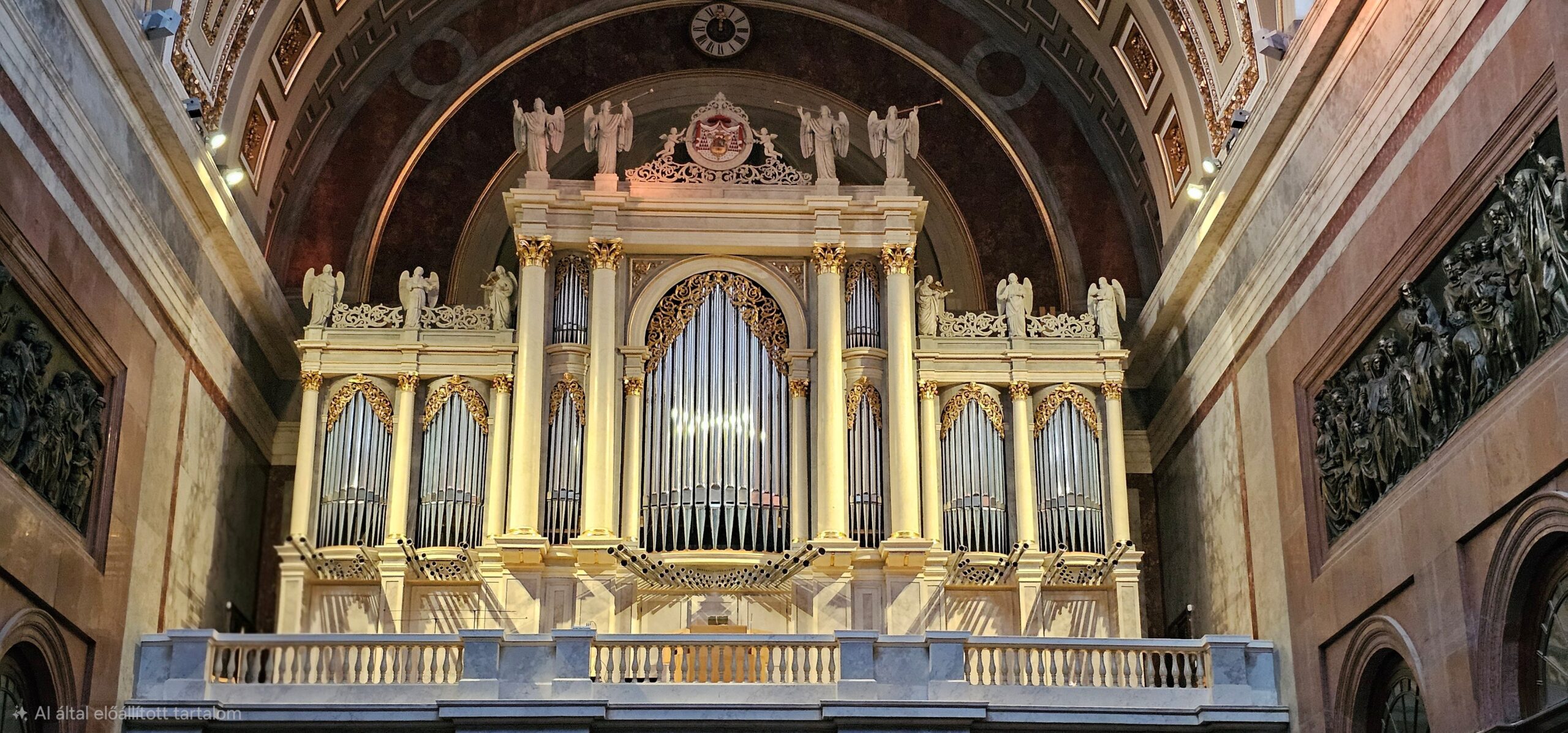
Reflections by Dávid András Homolya, an international organ expert, on the consecration of the organ at Esztergom Basilica:
„It was almost finished. We kept the intonators company whilst they were working, during an expert meosis session that was originally planned to be brief but ended up taking longer than expected. But really, no one can blame an enthusiastic organist at a time like this; the organ bench is sticky, and it’s hard to get up from it. And how wonderful it is that Péter couldn’t tear himself away from the keys for a good twenty minutes. Because I, too, did not want that transcendent experience that penetrated to the very marrow, the embrace of the cathedral of sound, time standing still, that pure, spiritual delight to come to an end. Sentiment océanique. Those few minutes of celebration that crept into everyday life through the entry for an unremarkable day on the calendar. Maurice Duruflé’s heroic tribute to the memory of Jehan Alain has always struck me as a charming, atmospheric work – yet one that is, in a typically French way, light-hearted, almost superficially sparkling. Then, from time to time, I am struck by the masterpieces of organ music; I am struck by just how much more is achieved when high-quality sound meets the atmosphere of the church during the performance of a particular piece. Sometimes I think that the magic of 19th- and 20th-century French organ music lies in one particular secret: the unique, unmistakable atmosphere created by the sound of the organ and the church interior. It is rather like Italian cuisine, where a slapdash, well-rehearsed, quick recipe does not, in itself, amount to anything truly marvellous. But if the oregano and basil were grown on the slopes of Umbria, the tomatoes on the ash of Vesuvius, the cheese made from raw milk from Modena, the slow-dried bronze-cut pasta produced at the heel of the Italian boot, and the olives ripened by the Sicilian sun, then the overall effect is inimitable.
Something similar happened on Tuesday with Duruflé’s piece in Esztergom. It came to life with stunning sound quality – the likes of which I have never heard anywhere before. Maurice Duruflé’s work, which has been relegated to the margins of universal music history dominated by the pantheon of Debussys, Ravels, Mahlers and Richard Strausses, provided a musical experience on a par with a symphonic poem by Strauss. The organ evoked the sensation of a perfect orchestra with such dynamic cantabile phrases, as if the instrument were studded with all the technical gadgets of recent decades. But no, those don’t come close to creating such a dynamic illusion. The developers are looking for the secret in the wrong place. Never mind… One way or another, Esztergom is a phenomenon! It has turned Duruflé into gold. This is, of course, no slight on the composer. I find myself realising time and again that the character of the French symphonic organ and the acoustics of the cathedral are simply woven into works like this.
In fact, the piece of music can only truly come into its own when played alongside them. This, therefore, is not a shortcoming, but an exciting and beautiful tradition. And it is also a test of the organ’s capabilities. Perhaps this is precisely why Duruflé’s work proved to be the best dress rehearsal for the Esztergom organ. As I listened, little folk songs and stray thoughts kindled in my soul… Twice in history, attempts were made to build an instrument befitting the cathedral’s highest status, with fine results, though the means at their disposal were limited. Mooser’s organ, built in 1855, was a representative instrument; viewed from a modern perspective, it had an archaic character, was almost old-fashioned for its time, somewhat provincial, with a weak wind system and sluggish action. The remains, spared by a bomb during the World War, were brought back to life by our good old Mr. Baróti, guided by his own brilliant artistic vision. We’d already sensed it, we’d already heard what might be said there. The great miracle would already have come to pass… had those ’70s and ’80s not been a washout. We’d already seen it half-finished. Then, along with Baróti, we thought that the organ of Hungary’s greatest and most prestigious church – along with all its historical trappings – would remain forever a pleasing vision, a mere sketch. And now, before my very eyes, this instrument is taking shape with a splendour that, without exaggeration, illuminates the whole of Central Europe. In the end, it turned out that neither the narrow confines of the Hungarian provinces, nor the bombs of the World War, nor the decadent fashions of the organ movement, nor communism, nor the unholy circumstances of the decades that followed could squander the investment of 150 years of intellect, strength and such a sacred will. Investments in history always pay off. This was precisely Baróti’s vision; he recognised the infinite richness and inexhaustible possibilities of the layering of times and eras. He simply could not have known that he and his era would not be the final layer in the instrument’s completeness. He was not destined to complete his work during his lifetime. But his persistent labour has now reached its fulfilment. In Esztergom today, the early Romantic Mooser and his Baroque predecessors, Liszt’s Romanticism, the pinnacles of Hungarian late Romanticism – Angster and Rieger – Baróti’s world of German neo-Baroque and French symphonic music, skilfully blended into an unified whole; Vági’s new choral work, which subtly interweaves historical layers; and our own contribution, as the generation of the first quarter of the twenty-first century, bringing this entire harmonious eclecticism together. It is a state of grace in which the finest organs in history were created. Such instruments can only be brought to fruition through centuries of refinement; they can never be the work of a single generation’s single endeavour. That is why, for all its brilliance, this organ remains elusive even to those who created it in its present form. It is an unique, almost mystical entity that can only be discovered with sufficient humility, but never fully fathomed. Perhaps this is why it functions so well in its own right, transcending all technical expertise, and imbues the space, the soul and the works with its myriad facets: Duruflé, Bach and Liszt alike.
On Tuesday, the organ was put through its paces in front of a handful of people. A miracle was born. For a single moment, I did not miss either Notre Dame or Saint Ouen, nor do I know of any objective yardstick by which Esztergom would weigh any less on the scales of sound quality. It is now, at last, truly an organ worthy of the status of the main cathedral of the historic Hungarian church organisation.
It is impossible to compete with its sound. Yet it is not meant to surpass the others, but to crown them. And above all, to nurture the hope that there will be a time when the Hungarian people will once again devote themselves so generously to eternal values – thanks to which the beautiful queen of our musical instruments has now come into being! This is the finest, most worthy primacy. As for Baróti, he is no longer a tragic hero who could never achieve the great goal of his life; his mission has now been fulfilled, and his work has blossomed a hundredfold. May God grant you long life, Pista, in Eternal Life! SDG!”
You can hear the organ here.